We’ve talked a little bit about school nutrition here – and certainly will continue to do so over the weeks and months ahead – but for now, here’s a chance to put your lunch where your mouth is.
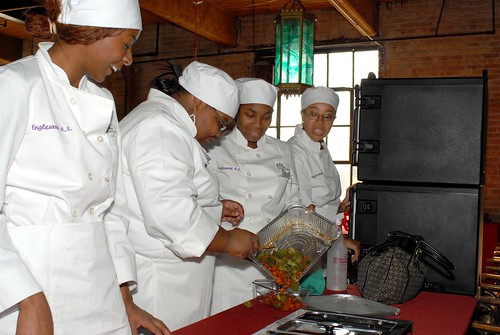
In a hands-on showdown that tips its hat to Iron Chef America, high school and college students across the country are invited to enter the Cooking up Change 2010 National Healthy Cooking Contest, hosted by the Healthy Schools Campaign and the National Farm to School Network.
The challenge? To create a healthy school lunch that meets stringent nutritional guidelines, using only ingredients that are available to the workers in school food service. In addition, contestants must use at least one locally grown food and the meal must, obviously, taste good. Not an easy task, by any means!
Interested students should form three-person teams and submit recipes by 5 p.m. EST on March 26. Based on those entries, three teams from the high school division and three teams from the college division will then be selected to receive an all-expenses paid trip to Taking Root, the National Farm to Cafeteria conference, to compete in the Cooking up Change finals.
The final round will include an in-kitchen battle, where the teams compete to prepare their meals and serve them to a panel of judges.
Interested in sautéing your way to change? Enter the competition now!
image © Healthy Schools Campaign
Thursday, February 11, 2010
Friday, February 5, 2010
Clean Your Plate: Around the Web This Week
Wishing everyone good luck out there this weekend as snowpocalypse 2.0 heads our way. Be safe, stay warm and break out the snowshoes.
Some things we liked this week:
image credit: Camera Slayer/Creative Commons
Some things we liked this week:
- Michael Pollan on Oprah (with video!). Something to note: the less we spend on food, the more we spend on healthcare. Who would you rather pay?
- Bye-bye NAIS: USDA drops plan to trace livestock. Small farms rejoice... then ask "What will replace it?"
- WaPo's Jane Black talks with Sen. Tom Harkin (D – Iowa), a long-time proponent of healthful eating, about Michelle Obama's new childhood obesity initiative.
- Urban farmers fight for their right...to grow veggies.
- Two different takes on school lunches -- basically the same result. Fed Up with School Lunch and School Lunch Found Guilty.
- What happens when a three-year-old starts looking at the beautiful food pics in Cooking Light?
image credit: Camera Slayer/Creative Commons
Wednesday, February 3, 2010
Hoops!
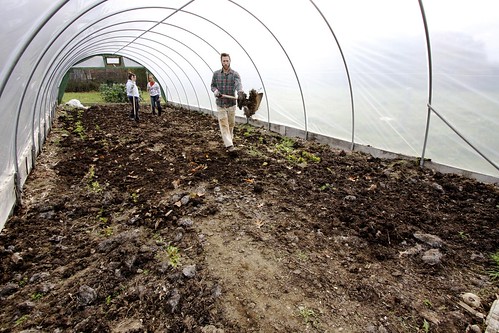
For anyone who lives in a climate that experiences seasons — hello, Virginia, sorry southern California — then it's not hard to imagine the value of having an insulated hoop house as part of your farm operation.
These greenhouse-like structures allow farmers to extend the growing season on both ends — earlier into spring and later into fall and winter. This can help farmers get a steady stream of income throughout the year which is a significant advantage to owners of small farms, limited-resource farmers and organic producers.
That's why it's exciting to hear that Virginia is part of a new pilot program being run by the U.S. Department of Agriculture’s Natural Resources Conservation Service that will provide funding for farmers to establish high tunnels to increase the availability of locally grown produce in a conservation-friendly way.
This pilot will test the potential conservation benefits of growing crops under these structures, and participating farms can receive funding for one high tunnel.
Local farmers who would like to sign-up for the high tunnel pilot should call or visit the NRCS office at a local USDA service center. USDA service center locations are listed on-line at http://offices.usda.gov.
image credit: Chewonki Semester School/Creative Commons
These greenhouse-like structures allow farmers to extend the growing season on both ends — earlier into spring and later into fall and winter. This can help farmers get a steady stream of income throughout the year which is a significant advantage to owners of small farms, limited-resource farmers and organic producers.
That's why it's exciting to hear that Virginia is part of a new pilot program being run by the U.S. Department of Agriculture’s Natural Resources Conservation Service that will provide funding for farmers to establish high tunnels to increase the availability of locally grown produce in a conservation-friendly way.
This pilot will test the potential conservation benefits of growing crops under these structures, and participating farms can receive funding for one high tunnel.
Local farmers who would like to sign-up for the high tunnel pilot should call or visit the NRCS office at a local USDA service center. USDA service center locations are listed on-line at http://offices.usda.gov.
image credit: Chewonki Semester School/Creative Commons
Tuesday, February 2, 2010
Raise Your Hand for Better School Lunches
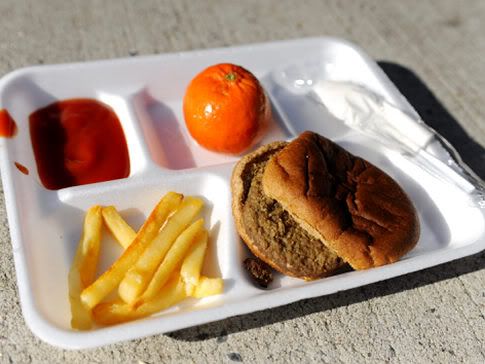
School lunch has been all over the news lately, and the reports aren't pretty. Not only are we feeding our kids beef that many fast food joints won't even touch, we're also counting the french fry as a vegetable, plastic-wrapping grilled cheeses, and serving pizza with more than 25 ingredients.
The thing is, it's not easy to make a healthy, nutritious school lunch on just one or two dollars. Which is just how much money is currently available per meal. Even Obama's newest budget proposal will only add an additional $.20 per kid.
And yet, the problem is more complicated than this. School lunches won't get better just because they cost more. It's going to take a thoughtful, refined effort to provide our children with the nutritious, healthy food they deserve.
That's why you should know about two important pieces of Virginia legislation that have been introduced this year. Both have the potential to get more healthy, locally-grown fruits and vegetables into our schools.
First up, one that could use your support:
Next up, a joint resolution that just passed last week. Hoorah!
So, your homework for tonight? Get the scoop on this latest legislation, and do what you can to help.
HB398: Summary | Actual Bill
image credit: Showalter for NY Daily News
The thing is, it's not easy to make a healthy, nutritious school lunch on just one or two dollars. Which is just how much money is currently available per meal. Even Obama's newest budget proposal will only add an additional $.20 per kid.
And yet, the problem is more complicated than this. School lunches won't get better just because they cost more. It's going to take a thoughtful, refined effort to provide our children with the nutritious, healthy food they deserve.
That's why you should know about two important pieces of Virginia legislation that have been introduced this year. Both have the potential to get more healthy, locally-grown fruits and vegetables into our schools.
First up, one that could use your support:
- HB398 would facilitate the purchase of Virginia-grown food products by state agencies, institutions and local public school divisions to the maximum extent possible. Virginia schools currently spend more than $6 million annually on fresh produce — shouldn't some (or all!) of that money stay right here in VA?
Next up, a joint resolution that just passed last week. Hoorah!
- HJ95 designates the second full week of November, in 2010 and in each succeeding year, as Virginia Farm-to-School Week in the Commonwealth. (In case you missed it, this very program helped the Local Food Hub supply 17 schools in our region with fresh fruits and vegetables this year. We look forward to keeping this tradition alive and well.)
So, your homework for tonight? Get the scoop on this latest legislation, and do what you can to help.
HB398: Summary | Actual Bill
image credit: Showalter for NY Daily News
Friday, January 29, 2010
Clean Your Plate: Around the Web This Week
Sounds like we're in for a snowy few days, folks... just in case you'd forgotten that it was winter. Here's a few things to keep you busy this weekend. Brew up a nice cup of hot chocolate, pull up the quilt and start clicking.
image credit: Todd Ehlers/Creative Commons
- Survey says: fruit and veggie consumption dropped in 2009. Bummer -- let's get that number up again in 2010.
- Find out how a grassroots push for student loan forgiveness could remove a barrier for new farmers...
- First year farmers: a nice piece on a small family farm chronicling the joys (and the growing pains) of starting up.
- All you can't eat: the sad story of food waste in our country.
- Going hungry: The hunger action group FRAC just released some distressing numbers on the rise of hunger in the U.S: 1 in 5 people experienced food insecurity in the last year.
image credit: Todd Ehlers/Creative Commons
Wednesday, January 27, 2010
Start Your Own Community Garden in C-ville
Community gardens are not just an urban phenomenon. Yes, in places like New York City, it's hard to walk a block or two without finding some tended patch of green, spilling out onto the sidewalk. In fact, New York boasts more than 600 gardens covering more than 32 acres — pretty impressive.
But they exist in less urban locales, too, like Charlottesville, which has at least three or four: Meadowcreek Gardens (off Morton Drive, behind the English Inn) and Azalea Park (off Old Lynchburg Road near 64) both have community garden plots where residents can rent space to grow flowers and vegetables, and others can be found on Sixth Street and Ridge Street.
Word on the street, however, is that it's nigh on impossible to get a plot at most of these gardens — that's how popular they are. Which leads me to believe we need more community gardens — a lot more. And now, there's a great opportunity for some motivated individuals or groups to make something happen.
Tom's Garden is a new organization making "seed money" grants for community gardens in our area. They consider applications from any group: individuals, homeowner's associations, public and non profit orgs, schools — basically anyone who has the vision and elbow grease to make it happen.
The application is available on their website. So what are you waiting for? It's practically spring — get growing!
image credit: itzafineday/Creative Commons
But they exist in less urban locales, too, like Charlottesville, which has at least three or four: Meadowcreek Gardens (off Morton Drive, behind the English Inn) and Azalea Park (off Old Lynchburg Road near 64) both have community garden plots where residents can rent space to grow flowers and vegetables, and others can be found on Sixth Street and Ridge Street.
Word on the street, however, is that it's nigh on impossible to get a plot at most of these gardens — that's how popular they are. Which leads me to believe we need more community gardens — a lot more. And now, there's a great opportunity for some motivated individuals or groups to make something happen.
Tom's Garden is a new organization making "seed money" grants for community gardens in our area. They consider applications from any group: individuals, homeowner's associations, public and non profit orgs, schools — basically anyone who has the vision and elbow grease to make it happen.
The application is available on their website. So what are you waiting for? It's practically spring — get growing!
image credit: itzafineday/Creative Commons
Tuesday, January 26, 2010
Apply Now: Farming Apprenticeship with the Local Food Hub!
America's farming demographic is aging. Rapidly.
According to the latest Census of Agriculture, the average age of a U.S. farmer is 57.2, and that's not all. The average American small farmer is over 60. More than one out of every four farmers is over 65 years old and rapidly facing retirement, and less than 6% of all American farmers are younger than 35 years old.
If you haven't thought about it before, now's the time to take a minute and consider: who will grow our food in 10, 15, or 20 years?
Could it be you? In addition to providing services and support to our current generation of small farmers, the Local Food Hub is dedicated to inspiring and developing the next generation of farmers through workshops, classes and hands-on activities.
That's why we're proud to announce our first apprenticeship opportunity at our educational farm. Apprentices will perform a wide variety of tasks including planting, mulching, laying irrigation, organic pest management, harvesting and packing produce, and working with the public and selected teenage interns in a mentor capacity. Further knowledge in areas such as soil improvement, crop planning, and farm machinery is possible for motivated individuals. Get all the details here.
This is a unique opportunity to get your hands in the ground and make a difference -- don't miss it!
According to the latest Census of Agriculture, the average age of a U.S. farmer is 57.2, and that's not all. The average American small farmer is over 60. More than one out of every four farmers is over 65 years old and rapidly facing retirement, and less than 6% of all American farmers are younger than 35 years old.
If you haven't thought about it before, now's the time to take a minute and consider: who will grow our food in 10, 15, or 20 years?
Could it be you? In addition to providing services and support to our current generation of small farmers, the Local Food Hub is dedicated to inspiring and developing the next generation of farmers through workshops, classes and hands-on activities.
That's why we're proud to announce our first apprenticeship opportunity at our educational farm. Apprentices will perform a wide variety of tasks including planting, mulching, laying irrigation, organic pest management, harvesting and packing produce, and working with the public and selected teenage interns in a mentor capacity. Further knowledge in areas such as soil improvement, crop planning, and farm machinery is possible for motivated individuals. Get all the details here.
This is a unique opportunity to get your hands in the ground and make a difference -- don't miss it!
Subscribe to:
Posts (Atom)